Architecture🔗
RSigma is a workspace of eight crates organised around one principle: rule processing and event evaluation are pure library code; everything I/O-bound or runtime-shaped is layered on top. This page documents the crate map, the execution shapes, and how the pieces interact at runtime.
For operator-facing material see the User Guide. For per-crate API docs see docs.rs/rsigma.
Ecosystem🔗
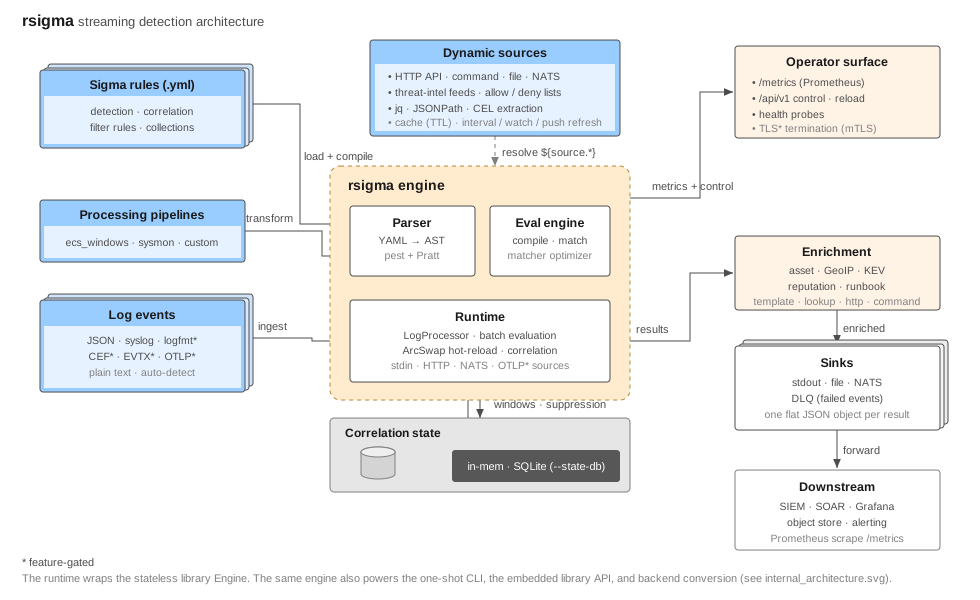
The streaming-detection ecosystem at a glance: rules, pipelines, dynamic sources, and log events flow into the engine, which fans out to enrichment, sinks, and downstream systems.
Crate map🔗
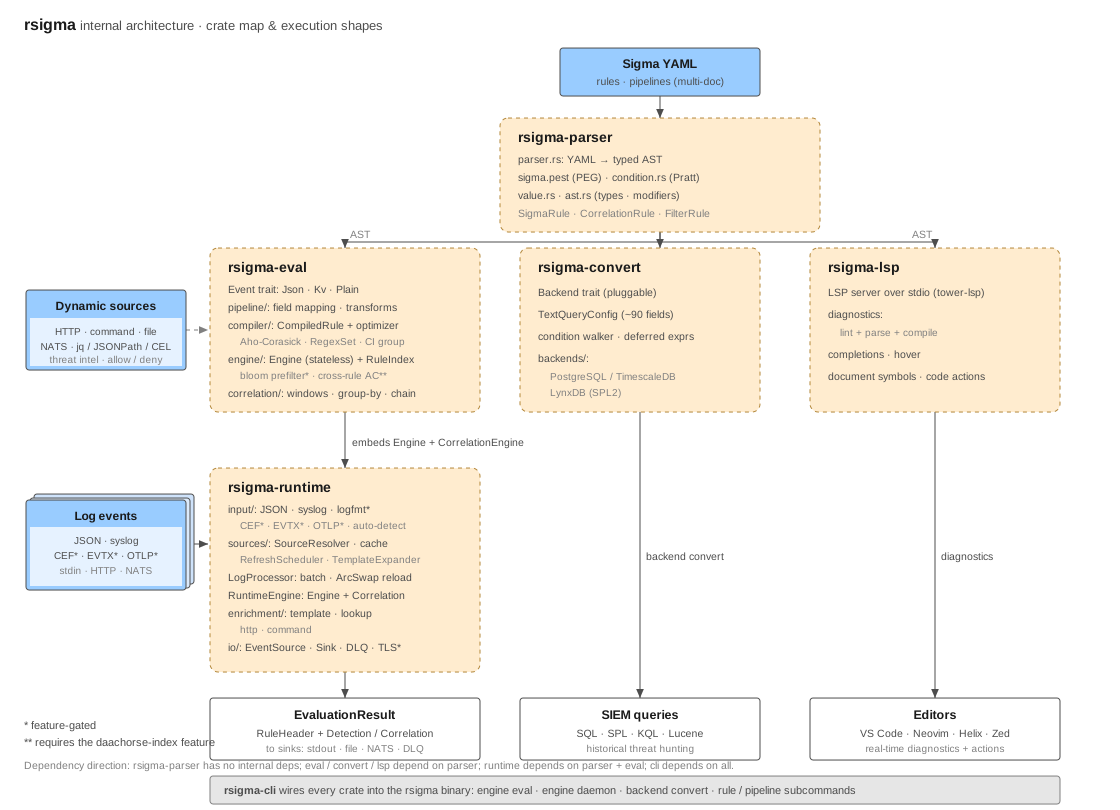
The crate-level view below is also available as a rendered SVG.
flowchart TD
    YAML["YAML input"]
    SERDE["yaml_serde"]
    EVENTS["Log events"]
    OUTPUT["EvaluationResult<br/>RuleHeader: title · id · level · tags · enrichments<br/>ResultBody: Detection (matched fields/selections) ·<br/>Correlation (correlation_type · group_key · aggregated_value)"]
    QUERIES["SQL · SPL · KQL · Lucene · EDR rules<br/>30+ targets via sigma-cli"]
    EDITOR["Editor diagnostics + code actions"]
    AGENTS["MCP clients<br/>Cursor · Claude Code · remote agents"]
    MCPJSON["Structured JSON<br/>AST · lint findings · matches · queries · fields"]

    subgraph rsigma-parser
        direction TB
        PARSE["parser.rs (YAML → AST)"] -->|"SigmaRule · CorrelationRule<br/>FilterRule · SigmaCollection"| PEST["sigma.pest (PEG grammar)<br/>condition.rs (Pratt parser)"]
        PARSE --> VALUE["value.rs<br/>SigmaStr · wildcards · timespan"]
        PARSE --> AST["ast.rs<br/>AST types · modifiers · enums"]
    end

    subgraph rsigma-eval
        direction TB
        ETRAIT["Event trait<br/>JsonEvent · KvEvent · PlainEvent<br/>schema classify (content signatures)"]
        ETRAIT --> EPIPE["pipeline/<br/>Pipeline · conditions · transformations<br/>state · finalizers<br/>builtin: ecs_windows · sysmon<br/>dynamic: ${source.*} template expansion"]
        EPIPE --> ECOMP["compiler/<br/>compile_rule → CompiledRule<br/>matcher optimizer (AnyOf):<br/>Aho-Corasick batching (|contains)<br/>RegexSet batching (|re)<br/>CaseInsensitiveGroup"]
        ECOMP --> EENG["engine/<br/>Engine (stateless)<br/>prefilters:<br/>RuleIndex (exact-value pruning)<br/>bloom trigram filter* (substring)<br/>cross-rule AC index** (daachorse)<br/>logsource pruning (conflict-based, product-partitioned)"]
        EENG --> ECORR["correlation/<br/>sliding windows · group-by<br/>chaining · suppression · introspect snapshot"]
        ECORR --> ECUST["rsigma.* custom attributes"]
    end

    subgraph rsigma-convert
        direction TB
        CBACK["Backend trait<br/>pluggable query generation"]
        CBACK --> CTQC["TextQueryConfig<br/>~90 fields for text query backends"]
        CTQC --> CWALK["Condition walker<br/>deferred exprs · conversion state"]
        CWALK --> CENDS["backends/<br/>native: PostgreSQL/TimescaleDB · LynxDB · Fibratus<br/>TextQueryTest (test)<br/>else → sigma-cli delegation (splunk · elastic · kusto · ...)"]
    end

    subgraph rsigma-lsp
        direction TB
        LSERV["LSP server over stdio<br/>tower-lsp"]
        LSERV --> LDIAG["diagnostics<br/>lint + parse + compile"]
        LDIAG --> LFEAT["completions · hover<br/>document symbols"]
        LFEAT --> LEDIT["Editors<br/>VS Code · Neovim · Helix · Zed"]
    end

    subgraph rsigma-runtime
        direction TB
        RINPUT["input/ format adapters:<br/>JSON · syslog · logfmt* · CEF* · EVTX*<br/>plain text · auto-detect<br/>raw line → EventInputDecoded"]
        RINPUT --> RPROC["LogProcessor<br/>batch evaluation<br/>ArcSwap hot-reload (rules + pipelines)<br/>MetricsHook · EventFilter"]
        RPROC --> RENG["RuntimeEngine<br/>wraps Engine + CorrelationEngine<br/>with rule loading<br/>schema routing*: per-schema engines<br/>+ one shared correlation store"]
        RENG --> RENRICH["enrichment/ post-eval pipeline<br/>primitives: template · lookup · http · command<br/>kind-aware: ${detection.*} · ${correlation.*}<br/>scope filter · HTTP response cache · on_error<br/>writes RuleHeader.enrichments"]
        RENRICH --> RPOST["post-engine layers (opt-in)<br/>risk/ per-entity scoring + risk incidents<br/>alert pipeline/ silence · inhibit ·<br/>dedup · incident grouping<br/>dispositions/ per-rule false-positive ratio"]
        RPOST --> RIO["io/<br/>EventSource (stdin · HTTP · NATS · unix*)<br/>OTLP* (HTTP + gRPC)<br/>TLS* termination (mTLS · cert hot-reload)<br/>on shared API listener (TCP or unix*)<br/>Sink (stdout · file · NATS · OTLP* · webhook · unix*)<br/>async delivery: per-sink workers · retry/backoff · DLQ"]
        RSRC["sources/ (dynamic pipelines)<br/>DaemonSourceRegistry: external (--source) +<br/>pipeline-embedded (deprecated) · collision-error<br/>SourceResolver: HTTP · command · file · NATS<br/>TemplateExpander · SourceCache (SQLite TTL)<br/>RefreshScheduler: interval · watch · push<br/>SIGHUP · NATS control · includes<br/>extract: jq · JSONPath · CEL"]
    end

    subgraph rsigma-mcp
        direction TB
        MCPSERVE["rsigma mcp serve<br/>stdio · Streamable HTTP (bearer auth · TLS)"]
        MCPSERVE --> MCPH["RsigmaMcp handler<br/>12 tools: parse_rule · parse_condition · lint_rules<br/>validate_rules · evaluate_events · convert_rules<br/>list_backends · list_fields · resolve_pipeline<br/>list_builtin_pipelines · fix_rules · author_ads<br/>4 resources: lint catalogue · ADS schema · modifiers · MITRE tactics"]
    end

    YAML -->|"Raw YAML Value"| SERDE
    SERDE --> PARSE
    PEST --> ETRAIT
    PEST --> CBACK
    PEST --> LSERV
    ECUST --> RENG
    EVENTS --> RINPUT
    RIO --> OUTPUT
    CENDS --> QUERIES
    LEDIT --> EDITOR
    RSRC -.->|"${source.*} values"| EPIPE

    AGENTS -->|"JSON-RPC"| MCPSERVE
    MCPH -.->|"parse · lint · fix · reference"| PARSE
    MCPH -.->|"compile · evaluate · fields"| ETRAIT
    MCPH -.->|"convert"| CBACK
    MCPH -.->|"sources · enrichment"| RSRC
    MCPH --> MCPJSON
* feature-gated. ** requires the daachorse-index feature.
rstix🔗
STIX 2.1 bundle parsing, semantic validation, and patterning live in the rstix crate. Data model, Pattern Engine (STIX §9), API, tests, and feature flags are documented on the rstix library page and in the crate README.
Crate responsibilities🔗
The dependency direction goes left to right in the diagram above. Higher crates depend on lower crates; the reverse is never true.
| Crate | Role | Key types | Feature gates |
|---|---|---|---|
rsigma-parser | YAML → AST. The only crate that touches Sigma source. | SigmaCollection, SigmaRule, CorrelationRule, FilterRule, Condition, SigmaStr, Modifier | — |
rsigma-eval | Compile AST to a matcher tree, evaluate events. Detection and correlation engine. Processing pipeline machinery. | Engine, CorrelationEngine, Pipeline, Transformation, CompiledRule, Event, JsonEvent, MatchResult, CorrelationResult | parallel, daachorse-index |
rsigma-convert | Lower the parser AST into backend-native queries. Non-native targets are delegated to sigma-cli. | Backend trait, TextQueryConfig, PostgresBackend, LynxDbBackend, FibratusBackend, TestBackend | — |
rsigma-runtime | Streaming runtime. Input adapters, post-evaluation enrichment, sinks, dynamic-source resolver, NATS/OTLP plumbing, hot-reload. | LogProcessor, RuntimeEngine, EventSource, Sink, EnrichmentPipeline, SourceResolver, SourceCache, TemplateExpander, EvtxFileReader | nats, otlp, logfmt, cef, evtx, daachorse-index |
rsigma-lsp | Language Server Protocol for editors. Diagnostics from the linter + parser + compiler, plus completions, hovers, and symbols. | Backend (tower-lsp impl), Diagnostic mapping | — |
rsigma-mcp | Model Context Protocol server. Exposes the parser, linter, fixer, evaluator, converter, field extraction, and pipeline resolution as MCP tools and resources for AI agents, returning structured JSON. | RsigmaMcp handler, serve_stdio | http |
rstix | STIX 2.1 + TAXII 2.1 library crate (Data Model + Serialization complete; Pattern Engine parse + type-check + evaluation behind pattern). | Bundle::parse / parse_reader, Bundle::validate, ParseOptions + typed TypeRegistry, 42 typed object families, Pattern::parse / evaluate / matches_single / matches_single_with_bundle / evaluate_observed_data (pattern), model::validate invariants, deterministic SCO IDs, vocabulary tables | serde, pattern |
rsigma-cli | The rsigma binary. Wires the other crates into a CLI and the streaming daemon. | engine eval, engine daemon, rule *, backend *, pipeline resolve | daemon, daemon-nats, daemon-otlp, plus all eval/runtime feature flags. |
rsigma-parser has no Rust dependencies on the others. rsigma-eval, rsigma-convert, and rsigma-lsp depend on rsigma-parser and nothing else above it. rsigma-runtime depends on rsigma-parser and rsigma-eval. rsigma-mcp depends on rsigma-parser, rsigma-eval, rsigma-convert, and rsigma-runtime. rsigma-cli depends on everything.
The four execution shapes🔗
The same compiled rules can be evaluated in four shapes; each is a different entry into the same engine.
1. Library🔗
A program embeds rsigma-parser and rsigma-eval directly:
let collection = rsigma_parser::parse_sigma_yaml(yaml)?;
let mut engine = rsigma_eval::Engine::new();
engine.add_collection(&collection)?;
let event = rsigma_eval::JsonEvent::borrow(&json);
let matches = engine.evaluate(&event);
No I/O, no thread spawning, no async runtime. The same Engine struct backs every other shape.
2. One-shot CLI (engine eval)🔗
rsigma-cli reads rules and events, instantiates Engine, evaluates each event, prints MatchResult lines to stdout, exits. Useful for fixtures, hunts, and forensic replay over .evtx. See engine eval and Evaluating Rules.
3. Streaming daemon (engine daemon)🔗
rsigma-cli's daemon subcommand wires rsigma-runtime's LogProcessor around RuntimeEngine (which embeds Engine + CorrelationEngine). Adds:
- One
EventSource(stdin, HTTP, NATS, or aunix://domain socket on Unix targets behind theudsfeature). - A post-evaluation
EnrichmentPipelinethat injects context into each result before it reaches the sinks. - Optional post-engine layers in the sink path, all off by default: a risk layer (
--risk) that scores firings per entity and emits risk incidents, and an alert pipeline (--alert-pipeline) that silences, inhibits, deduplicates, and groups results into incidents. When both run the order is enrichment, risk, alert pipeline, sinks. - An optional triage feedback loop (
--enable-dispositions) that ingests analyst verdicts off the result stream and maintains a per-rule false-positive ratio. It is orthogonal to the eval and sink paths. - Optional schema-aware routing (
--schema-routing) that classifies each event and dispatches it to a per-schemaEngine, feeding one shared correlation store; and optional conflict-based logsource pruning (--logsource-routing). - One or more
Sinks (stdout, file, NATS, OTLP, webhook, or aunix://socket), fanned out through a per-sink async delivery layer (bounded queue + worker, retry/backoff), plus an optional DLQ. - Hot-reload via
ArcSwap(file watcher +SIGHUP+POST /api/v1/reload). - Optional SQLite-backed state (
--state-db) for correlation, alert-pipeline, risk, and disposition snapshots. - Optional OTLP receiver (HTTP + gRPC) when built with
daemon-otlp. - Optional in-process TLS termination (mTLS, cert hot-reload) on the shared API listener when built with
daemon-tls(TCP only; aunix://listener is the trust boundary instead). - Prometheus
/metrics, REST control endpoints (status, reload, the opt-in tap and tail streams, and read-onlycorrelations,incidents,silences,risk, anddispositionsviews), health probes.
See Streaming Detection and the engine daemon flag table.
4. Backend conversion (backend convert)🔗
rsigma-convert's Backend trait drives a recursive walk over the parser AST and emits backend-native queries (SQL, SPL2) or rule documents. The trait uses TextQueryConfig (around 90 fields mirroring pySigma's TextQueryBackend configuration) to keep backend implementations declarative.
PostgreSQL/TimescaleDB, LynxDB, and Fibratus (rule YAML for Windows EDR sensors) are the native targets today. backend convert resolves targets native-first: any target without a native backend is delegated to an installed sigma-cli, so the wider pySigma backend ecosystem (Splunk, Elasticsearch, Microsoft Sentinel/KQL, QRadar, and 30+ more) is reachable from the same command. See backend convert, PostgreSQL backend, LynxDB backend.
Plus: LSP🔗
rsigma-lsp runs over stdio via tower-lsp. On every save, it parses, lints, and compiles the buffer through rsigma-parser + rsigma-eval, then maps any findings into LSP diagnostics. It also exposes completions, hovers, and document symbols. See VS Code and Neovim.
Plus: MCP🔗
rsigma-mcp exposes the toolchain to MCP-aware agents (Cursor, Claude Code, ...) over stdio, and over Streamable HTTP (with bearer-token auth and TLS) behind the http feature. The RsigmaMcp handler wraps rsigma-parser, rsigma-eval, rsigma-convert, and rsigma-runtime behind 12 tools (parse, lint, fix, validate, evaluate, convert, list backends and fields, resolve and list pipelines, and author ADS metadata) and 4 resources (the lint catalogue, the ADS schema, the modifier reference, and MITRE tactics), returning structured JSON. It is driven by rsigma mcp serve. See the MCP server guide.
Data flow🔗
YAML to AST (rsigma-parser)🔗
.yml file → yaml_serde::Value → SigmaCollection {
    rules:        Vec<SigmaRule>,
    correlations: Vec<CorrelationRule>,
    filters:      Vec<FilterRule>,
}
- Multi-document YAML (
---) maps toSigmaCollectionwith each document parsed into the appropriate kind. - Conditions go through a separate Pratt parser (
condition.rs) that consumes the Sigma condition expression grammar withnot > and > orprecedence. - The parser is strict on the spec: unknown top-level keys fail compilation; unrecognised modifiers fail compilation. (Linting is a separate pass that surfaces best-practice issues without failing compilation.)
AST to compiled rules (rsigma-eval::compiler)🔗
Engine::add_collection first runs every loaded pipeline against each rule, in priority order, then compiles the rewritten rules into CompiledRule. Compilation builds the matcher tree: a tree of nodes per detection item, with the matcher optimizer transforming subtrees in-place.
The matcher optimizer makes three transparent rewrites:
| Pass | Trigger | Effect |
|---|---|---|
| Aho-Corasick batching | AnyOf group of 8+ contains needles | Collapses into one Aho-Corasick automaton. |
| RegexSet batching | AnyOf group of 3+ regex matchers | Collapses into one regex::RegexSet. |
CaseInsensitiveGroup | A group whose children are all case-insensitive | Lowercases the haystack once, dispatches via matches_pre_lowered. |
See Performance Tuning: the matcher optimizer.
Event evaluation (rsigma-eval::engine)🔗
For each event:
- Apply opt-in pre-filters in order:
RuleIndexexact-value pruning (always on).- Conflict-based logsource pruning (
set_logsource_extractor), backed by a product-partitioned rule index, when logsource routing is enabled. - Bloom trigram filter (
set_bloom_prefilter(true)). - Cross-rule Aho-Corasick (
set_cross_rule_ac(true), requiresdaachorse-indexbuild feature). - For each candidate rule, walk the matcher tree against the event.
- Emit a
MatchResultper firing detection. - Feed every firing detection into
CorrelationEngine; any correlation that crosses its threshold emits aCorrelationResult.
The engine itself is stateless. Correlation state lives on the CorrelationEngine, with a hard cap (max_state_entries, default 100,000; 10% eviction on overrun). See Performance Tuning: memory pressure and correlation state.
With schema-aware routing the daemon classifies each event by its content signature and builds one Engine per distinct pipeline set, dispatching the event to the engine bound to its schema. Detections from every per-schema engine feed one shared CorrelationEngine, and group-by extraction is schema-aware, so the same entity correlates across schemas even when each names the field differently. See Schema Routing and Logsource Routing.
Streaming pipeline (rsigma-runtime)🔗
The streaming runtime wraps the synchronous Engine in an async pipeline:
EventSource ──► mpsc ──► LogProcessor ──► EnrichmentPipeline ──► post-engine ──► async sink layer ──► Sinks
   (stdin,                 (batch            (asset · GeoIP ·       layers           (per-sink queue       (stdout,
    HTTP,                   evaluation,       reputation ·          (risk · alert     + worker,             file,
    NATS,                   ArcSwap           runbook · ...)         pipeline,        retry/backoff)        NATS,
    OTLP,                   hot-reload)                              opt-in)                                OTLP,
    unix)                                                                                                  webhook,
                                                                                                           unix,
                                                                                                           DLQ)
The bounded mpsc channels apply back-pressure: when the engine cannot keep up, the source blocks instead of dropping events. rsigma_back_pressure_events_total counts how often that happens. See Observability.
ArcSwap hot-reload swaps an Arc<Engine> atomically; in-flight evaluations see the old engine and complete normally; new events get the new one. The reload path is triggered by a notify-based file watcher on the rules and pipeline files, by SIGHUP, or by POST /api/v1/reload.
Post-evaluation enrichment (rsigma-runtime::enrichment)🔗
Between the engine and the sinks, the EnrichmentPipeline injects context (asset info, IP reputation, identity, GeoIP, KEV flags, runbook URLs, ...) into each result's RuleHeader.enrichments map. Four primitives (template, lookup, http, command) compose into recipes. Kind-aware template namespaces (${detection.*} for detection-kind enrichers, ${correlation.*} for correlation-kind) are validated at config-load time. An optional HTTP response cache, scope filtering by rule glob, tag set, and severity, and on_error policies (skip, null, drop) round it out. See Enrichment.
Post-engine layers (rsigma-runtime::risk, ::alert_pipeline, ::dispositions)🔗
After enrichment and before the sinks, two opt-in layers reshape the result stream while leaving the evaluation hot path untouched. The risk layer annotates each firing with a per-entity risk score and risk objects (drawn from a shared field-selector namespace), accumulates risk per entity over a sliding window, and emits a RiskIncidentResult when an entity crosses a score or ATT&CK-tactic-count threshold. The alert pipeline then silences, inhibits, and deduplicates results (modeled on Alertmanager) and groups the survivors into IncidentResults. When both run the order is enrichment, risk, alert pipeline, sinks, since risk must accrue on every firing including the ones the alert pipeline is about to fold, silence, or inhibit. A separate triage feedback loop ingests analyst dispositions off the result stream to maintain a per-rule false-positive ratio; it is orthogonal to the sink path. All three persist versioned snapshots into the shared --state-db store, each in its own table. See Risk-Based Alerting, Alert Pipeline, and Triage Feedback.
Dynamic source resolution (rsigma-runtime::sources)🔗
On every rule-load (including reloads), the DaemonSourceRegistry collects source declarations (from external --source files, plus the deprecated pipeline-embedded sources: blocks, with collision-error semantics) and runs each through the SourceResolver machinery:
- Per source, dispatch on type: HTTP (
reqwest), command (tokioCommand), file (read + optionalnotifywatch), NATS (subject subscribe, requiresnatsfeature). - Parse the response according to
format:(json,yaml,lines,csv). - Apply the
extract:expression (jqviajaq, JSONPath viaserde_json_path, or CEL). - Store in
SourceCache(in-memory by default; SQLite-backed under--state-db). TemplateExpandersubstitutes the resolved values into the pipeline'svars:entries.
Refresh policies and on-error behaviour are documented in Dynamic Pipeline Sources.
Performance posture🔗
Three transparent passes (matcher optimizer) always run. Three opt-in passes (--bloom-prefilter, --cross-rule-ac, and the parallel rayon path enabled by default in the CLI) require explicit knobs. The streaming daemon's --buffer-size (default 10000) and --batch-size (default 1) tune throughput vs tail latency.
Verified Criterion numbers ship in the Benchmarks page. Headline figures: 2 µs per event for 100 rules, 30 µs per event for 1k rules, 162 µs per event for 5k rules. Cross-rule AC delivers up to ~100× speed-up on pure-substring rule sets dominated by non-matching events.
Threat model🔗
RSigma assumes a trusted operator providing rules, pipelines, and source declarations on disk, plus an event stream from a trusted upstream agent. Every external input is bounded by a hard limit (event size, condition size, response body size, command execution time, recursion depth) so a malformed input cannot exhaust memory or CPU. The daemon HTTP and gRPC listeners are unauthenticated today; either deploy behind a reverse proxy or build with the optional daemon-tls feature and terminate TLS in-process via the --tls-cert / --tls-key (and optionally --tls-client-ca for mTLS) flags. Full catalogue in Security Hardening.
See also🔗
- Source diagram — the Mermaid file this page renders from.
- Per-crate READMEs for the implementation-side documentation.
- docs.rs/rsigma for the library API.
- Benchmarks for the Criterion results across parser, evaluator, correlation engine, runtime, and dynamic pipelines.
- Performance Tuning, Observability, Security Hardening for the operator-facing concerns.